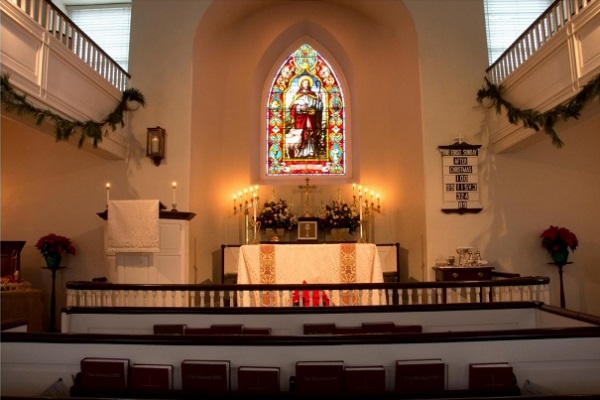
Sundays at St. James’
Holy Eucharist with music – In-Person and Online – 9:30 a.m.
We offer in person and online opportunities for Sunday morning following the order of worship from the Episcopal Book of Common Prayer. Our weekly worship includes readings from Holy Scripture, the singing of hymns, prayers for the Church and for the world, and the sharing of the Holy Eucharist. The term “Eucharist” is a Greek word meaning “Thanksgiving,” and it proclaims our thankfulness that we have been invited to join with others around the Holy Table, an image and foretaste of the Heavenly Banquet.
If you can’t join us in person, please following along with our Facebook Livestream, beginning shortly before 9:30 a.m. every Sunday morning.
https://www.facebook.com/StJamesEpiscopalChurchMillCreek/
Note: our virtual services are available on our website: www.stjamesmillcreek.org
During the communion time, you may wish to use this prayer
For Spiritual Communion
My Jesus, I believe that you are truly present in the Blessed Sacrament of the Altar. I desire to offer you praise and thanksgiving as I proclaim your resurrection. I love you above all things, and long for you in my soul. Since I cannot receive you in the Sacrament of your Body and Blood, come spiritually into my heart. Cleanse and strengthen me with your grace, Lord Jesus, and let me never be separated from you. May I live in you, and you in me, in this life and in the life to come. Amen.
– From Washington National Cathedral; material adapted from Prayer of St. Alphonsus de Liguori (1696-1787) and A Prayer Book for the Armed Services 2007
Roots of Our Sunday Worship Service
For over 300 years, faithful believers and seekers have gathered at our location in the heart of New Castle County, Delaware. While there is a special place in the heart for the historic building in which we gather, what is truly the soul of St. James’ Church is that for three centuries it has welcomed and nourished those who have regularly met here to worship, to learn and to serve the surrounding community. Over the years the primary resource we have used for the worship of God is The Book of Common Prayer. The tradition of this book began in England in 1549 and was carried to the American Colonies as early as 1607. It has gone through a number of revisions over the years with the latest version adopted for use in 1979. The current edition draws its inspiration from the orders of service and ancient prayers that Christians have used for more than 1,500 years, which is not to say that our worship is merely a reflection of the past. The language of our worship is contemporary with teachings that reflect the issues of our times and prayers that strive to bring the presence of God’s love and grace into the events of our lives. The pandemic has not changed our teachings or desire to bring and share God’s love and grace into the events of our lives.